

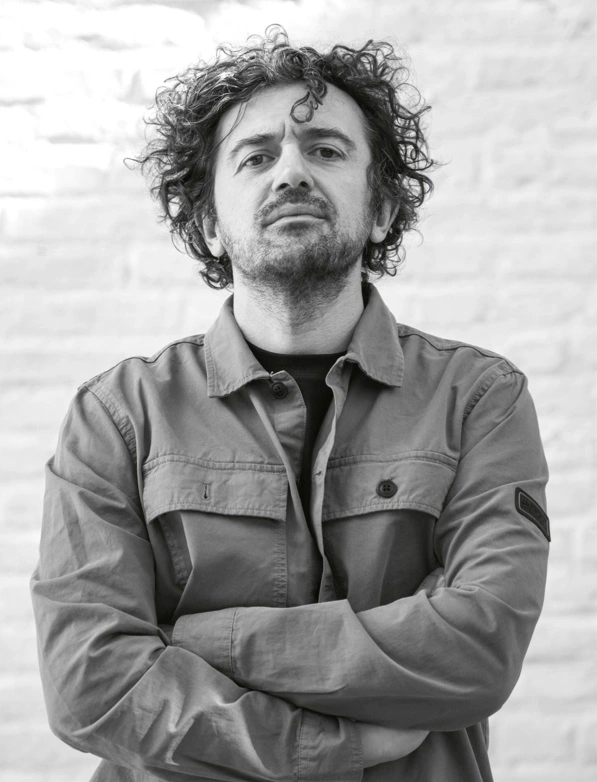

Jacopo Di Cera is an Italian artist whose creative practice brings together photography and digital art. He is a finalist in the National Geographic Photo Contest, with his work exhibited at renowned institutions such as Museo di Roma and Palazzo Valentini, as well as featured at events like the MIA Photo Fair and Les Rencontres de la Photographie.
This year, Di Cera became a featured exhibitor at the National Pavilion of the Republic of Sierra Leone for the 61st Venice Biennale, where he is presenting Ciclica. Created with the use of upcycled screens, a multimedia installation explores the vulnerability of life and the climate crisis.
About the evolution of artistic practice, the Ciclica project, and collective consciousness — read in Jacopo Di Cera’s interview with Weekly Minds.
In 2020, you began exploring digital art and NFTs with the project Infinity. How do you balance your creative practice between digital art and photography?
For me, photography and digital art are not two separate paths — they are two states of the same gaze. Photography is my way of collecting reality: it gives me matter, evidence, and the human presence inside landscapes. Digital art, instead, allows me to work on time: it extends an instant into duration, into repetition, into the psychological weight of an image that never ends. It helps me to explore new dimensions that photography can not get in.
With Infinity I understood that a loop can become a conceptual tool: if an emotion lasts the time of an action, what happens when the action becomes infinite? From there, I use photography as a foundation, an archive of the real, and digital as a language that transforms data, urgency, and contemporary fractures into an embodied experience. The “balance” is functional: I choose the medium that best serves what the work needs to say.
You are presenting your work in the National Pavilion of Sierra Leone. What does it mean for you, as an Italian artist, to place your vision of the ecological crisis within the context of an African pavilion and the broader theme Worlds of Today?
It feels both meaningful and necessary. The climate crisis is not an abstract topic; it is an uneven reality, its causes and its consequences are distributed asymmetrically across the world. Presenting Ciclica within an African pavilion invites a shift of perspective: it pushes me, as an Italian artist, to step outside a European-centered narrative and acknowledge that “Worlds of Today” are plural, interconnected, and often deeply unequal.
In that context, Ciclica becomes less about illustrating an emergency and more about positioning responsibility, vulnerability, and interdependence in the same frame. It’s a reminder that ecology is not only environmental — it is cultural, political, and human.
Art can achieve results where numbers, words, documents can not: creating awareness and consciousness, punch in a stomach, awakening people on this extremely important topic.
How does this synergy of different cultures influence the perception and meaning of Ciclica?
It expands the work from a personal statement into a shared space of interpretation. Ciclica is built on archetypes — birth, life, death — and on a universal figure: Gaia, interpreted by the incredible performer Lidia Carew, the Earth as a living body. But when the work is experienced through multiple cultural sensibilities, those archetypes stop being “my story” and become a mirror.
The synergy changes the meaning because it changes the questions the work triggers: not only what is happening to the planet, but also who pays the price, who is heard, who is invisible. That cultural plurality intensifies the ethical dimension of the installation and makes the audience more aware that the climate crisis is also a crisis of perspective.
Between the Venice Biennale, the Milan Cortina Olympics, and the Paralympics, 2026 is a massive year for your career. How do you think these various projects will shape the understanding of your artistic mission?
I see them as three chapters of one mission: using image-making to change the point of view literally and conceptually. My zenithal perspective removes hierarchy: it places bodies, landscapes, and signs of human presence on the same plane. That “democratization of the scene” helps me focus on relationships: between people, and between people and territory.
During the Olympics Games I had the chance to show for more than 5 months my study and artistic research on human relation with mountains with a huge installation and exhibition in Milano Malpensa Airport. Consequently, Shapes – the work dedicated to the italian para athletes through a deep study of their “interior” souls, expressed through their shadows, has been an intense journey, exhibited in Milan at Palazzo Regione.
The Biennale highlights the ecological and symbolic side of my research; the Olympics and Paralympics emphasize the human body — movement, resilience, identity — and the shadow as an intimate portrait of what we often don’t see. Together, these projects clarify that my mission is not to document reality, but to reframe it so that urgency becomes visible, and visibility becomes responsibility.
What exactly inspired you to create Ciclica?
Ciclica was born from a simple, almost physical intuition: the Earth behaves like a body, breathing, transforming, generating and dissolving, and yet we treat it as an infinite resource. I wanted to build an installation where the ecological crisis is not explained, but felt as a progressive loss of balance.
The narrative structure — birth, life, death comes from the idea that nature is cyclical. But the work asks what happens when that cycle is altered by our acceleration, extraction, and consumption. The use of upcycled screens is part of the same logic: the medium itself must participate in the ethics of the message.
In your opinion, what is the most critical theme within Ciclica? Why is it important?
The most critical theme is disappearance — how something living can fade while we are still watching it. In the installation, Gaia’s presence is slowly eroded by the visual accumulation of climate drivers and consequences. The choreography becomes less visible, until it vanishes.
This matters because we are living inside a paradox: the evidence of the crisis is everywhere, yet attention is fragile. Ciclica tries to make that contradiction tangible. It’s not only about the planet disappearing, it’s about our capacity to perceive, care, and act before disappearance becomes irreversible.
What is the core message you want the audience to take away from the installation?
I want the audience to leave with a clear sensation: the ecological crisis is not outside of us, it is happening to a body that we belong to. Gaia is not a metaphor at a safe distance; she is a mirror.
The core message is interdependence: what we do to the Earth, we do to ourselves. And the work closes with a question rather than an answer: if the cycle of nature is compromised, what kind of future and what kind of humanity will remain?

WeeklyMinds.com is proud to feature an author who brings a wealth of knowledge and experience to our blog. Weekly Minds is an accomplished freelancer writer with 12 years of experience in the field.
WeeklyMinds.com has a passion for sharing insights and perspectives on political, news, technology, home improvement, interiors and many more. Their unique perspective on current affairs has been featured in numerous publications and they have been a guest speaker at college fests.
WeeklyMinds.com is also an avid interest in writing and reading and enjoys singing, music, shopping, travelling and some more. In their free time, they can often be found of reading the novels and various current topics.
We are thrilled to have Elia Scala as a contributor to WeeklyMinds and look forward to their continued insights and contributions to our blog.