

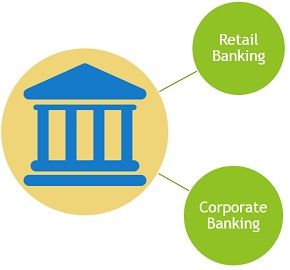
Commercial and corporate banking institutions make up one of the key components of modern financial systems by bringing together savers and borrowers and in turn enabling everyday economic activities and the expansion of major businesses. The two words, commercial and corporate banks, often work as synonyms but they actually refer to different yet related parts of the banking sector. Commercial banks are those that handle the daily banking needs of individuals, small businesses, and mid-sized enterprises with deposit and lending services as well as payment facilities. Corporate banking however deals first and foremost with large companies, government, and institutional clients that require complex financial services, e.g. credit arrangements, trade financing, cash management, and advisory services. Commercial and corporate banking institutions are this way the link between depositors and borrowers, risk mitigators, and enablers of commerce in the world.
Commercial banks offer savings and fixed-deposit accounts, and other banking products to the general public, and invest the deposits mainly in making loans and other financial investments. The most essential tasks of commercial banks are raising funds by saving through current, savings, and fixed-deposit accounts; providing credit of short- and medium-term maturity for working capital, personal, and small-business needs; running payment systems such as checks, transfers, and cards; and lastly offering basic money-handling and foreign-exchange services.
In some regions, commercial banks are legally able to conduct some investing operations besides lending. But, usually the law prohibits commercial banking from investment banking, in fact, mainly to make sure that depositors are kept safe. To ensure that financial services remain available, these organisations also open lots of branch offices and use internet services. Bank deposits be something important of the money supply and so their reliability is one reason the stability of such institutions is so essential. Corporate banking yet is focused on big corporations that need more sophisticated services beyond the scope of regular commercial or small-business banking.
Big corporations need significant credit facilities that are constantly available to them, capital expenditure loans (i.e. loans meant to finance the purchase of fixed assets), loans made by more than one bank, and tailor-made finance solutions for industries or projects. Corporate bankers further specialize in providing efficient cash-management systems across various entities and currencies, trade-finance tools like letters of credit and supply-chain financing, and risk-control devices including interest-rate and foreign-exchange products. In reality, many corporate banking departments are part of universal banks that also run retail (commercial) and investment banking departments so the cross-selling of services is enabled. Also, relationship managers form the heart of the process who get intimately acquainted with the client’s industry, the organisation’s financial and strategic plans, etc. to deliver a customised suite of credit and advisory products.
The boundary between commercial and corporate banking is usually not strictly defined. Many mid-market companies fall between both categories receiving commercial type services and over time gaining access to more involved corporate facilities as their business expands. Regulations play also a role in creating such boundaries. The old Glass -Steagall Act in the U.S. separated commercial banking on investment banking more or less entirely. Since then a more gradual approach has become apparent, in particular through new legislative changes in which such restrictions were reduced or removed altogether. In the U.S. the big commercial and corporate banks have commercial and investment-banking divisions in parallel whereas JPMorgan Chase, Bank of America, Citigroup and Wells Fargo also have a lot of commercial banking activities going with a good corporate and investment-banking business. European banks like HSBC, BNP Paribas, Deutsche Bank and Barclays are not only commercial and corporate banks but also retail and commercial ones which can provide a full range of products from personal to business banking. As for their corporate segment and trade finance capabilities, they have deep roots in international commerce.
Among the biggest financial institutions in the world that do commercial and corporate banking are the major banks in China like the Industrial and Commercial Bank of China (ICBC), the China Construction Bank (CCB), the Agricultural Bank of China (ABC), and the Bank of China (Boc). Their size reflects both the Chinese economy’s size and the state’s role in directing commercial banking to support industrial and infrastructure development. Japanese banks such as Mitsubishi UFJ and Sumitomo Mitsui and also other banks in India, Singapore, and Australia offer not only banking services to domestic commercial clients but also financial loans for large corporations. Both domestic and international banks compete on more than the size of their assets. Besides having a large balance sheet, they invest in technology to deliver banking services better, develop sector-related expertise, and have enough resources to arrange big transactions on an international level. Their main customers are local and overseas firms who need a wide variety of financial support and products from these banks.
To be sure, the role that commercial and corporate banking institutions play in the economy has many different aspects. Besides collecting savings and granting loans, these banks help people manage their monthly budget, allow business to build up inventories, and even let the government borrow money to build new schools. Daily transactions rely first and foremost on payment systems offered by commercial banks which make the whole operation of trade, including cross-border trade, quite smooth. For that, corporate banks use the trade finance, letter of credit, and banking services to support their clients.
The availability of financing by banks during prosperous times is a key driver of economic activity; conversely, when things are falling apart, a sudden stop to lending, the worsening of asset quality of loan books, and other problems in loan portfolio could bring about a sharp increase in financial stress across the system. Obviously the central banks keep a close eye on banks and their operations to ensure that the financial system in the country works efficiently, remains stable and safe. Commercial and corporate banks are often used not only as tools for monitoring and checking but also for implementing central bank policies. They influence the economy as the central banks use the banks as conduits for monetary policy so that in the end rates of interest as well as availability of credit to the public and private sector can be effectively controlled.
The technological changes are reflected in both segments. The introduction of digital banking services, apps for mobile, and payment systems that operate at the instant level have been the main factors in the reduction of delivery costs in serving retail and small-business clients, which has enabled a commercial banks’ outreach to be broadened while their margins from products that are conventional have been minimized. As for the corporate banking side, there’s now electronic platforms for cash management, trade document handling, administration of syndicated loans, and so on that have quite a bit enhanced the efficiency and the degree of transparency.
It is nowadays data analytics and AI that are helping in credit decision-making, fraud checking and recommendation of custom made products. But, fintech innovators and non-financial institution lenders have been able to carve out a space in some segments like payment processing, invoice finance and supply chain finance and thereby are creating pressure on the establishment that is traditional to either partner or invent themselves new. Further competition can be expected from open banking rules in different places because these rules require banks’ sharing of their customer data (by mutual agreement) with any third-party service.
Risk management still a crucial area. Commercial banks are exposed to credit risks due to their lending activities to individuals and to a greater extent, to small businesses. They also encounter interest-rate risks from differences in maturity of liabilities and assets; deposits have usually been of a short term while a bank’s investments or loan assets are typically of a long term. They but suffer from operational risks due to systems failure or human error and liquidity risks as a case of depositors suddenly withdrawing their funds, for example. Whereas it is mainly the corporate banks who are exposed to single-counterparty credit risks that are significant; risk of the type in which risk exposure is concentrated in a particular industry or geographical area and, risk of losing money from the market activities.
To be able to face these types of risks banks of the first kind as well as those of the second have been subjected to stricter capital requirements that would allow the former to raise their capacity levels against unexpected losses and the latter have also undergone rigorous stress-testing measures for identifying their level of resistance under crisis circumstances. There’s also a big issue of environmental, social, and governance (ESG) aspects, which are becoming increasingly vital that many institutions already factor climate-risk evaluations in when they grant loans or present sustainable-financing services which price is made conditional on environmentally responsible performance.
One of the challenges that banks have to deal with is Truth is in some markets interest rates are extremely low or even negative for a long time. These low or negative rates are not just causing the bank’s operating income to drop because of narrower interest rate margins, as they also lead to increased compliance costs for anti-money-laundering efforts and sanctions compliance. Challenges such as cyber security threats, modernization of outdated systems, and the need to comply with various regulations are also on the list.
Geopolitical tensions and trade disputes may affect international corporate banking, whereas demographic changes and evolving customer demands call for permanent adjustments to the banking service models. Mergers of different business entities have led to the formation of bigger and more intricately structured organizations, with the result that one will probably wonder about their criticality in the financial system and the necessity for resolution mechanisms that can deal with a major entity’s failure without taxpayers bearing the cost.
Commercial and corporate banking entities can only keep developing if the external environments are the catalysts. A greater reliance on digital ways, fintech integration at the point of purchase, and platform-style systems will most possibly redefine the old lines separating banks and other financial service providers. The proportion of money that goes into capital investments will more and more be decided by standards about environmental and social impact factors, and so will the investment decisions. It has long been the corporate banks’ strength that they have a thorough knowledge and trust relationship built up with the customers, as it helps them win deals for large transactions. But these days more and more reliance is placed not only on such relationship-based approach but also on data analytics for decision-making and speed of operation as they are also factors.
Those banks which will, in the end, manage to strike a fair balance between the two sides of the coin – conservative risk management and the creation of new products – will Definitely have the upper hand when it comes to the business of channeling capital towards its most productive use and maintaining a secure and efficient network of payments. For one, they will act as the pillars of the real economy’s ability to intermediate capital smoothly and maintain stable payment systems and, on the other, they will stand as a guarantee against future financial and economic crisis as their resilience and flexibility are the key to ensuring economic stability and growth in the long run.

WeeklyMinds.com is proud to feature an author who brings a wealth of knowledge and experience to our blog. Weekly Minds is an accomplished freelancer writer with 12 years of experience in the field.
WeeklyMinds.com has a passion for sharing insights and perspectives on political, news, technology, home improvement, interiors and many more. Their unique perspective on current affairs has been featured in numerous publications and they have been a guest speaker at college fests.
WeeklyMinds.com is also an avid interest in writing and reading and enjoys singing, music, shopping, travelling and some more. In their free time, they can often be found of reading the novels and various current topics.
We are thrilled to have Elia Scala as a contributor to WeeklyMinds and look forward to their continued insights and contributions to our blog.