

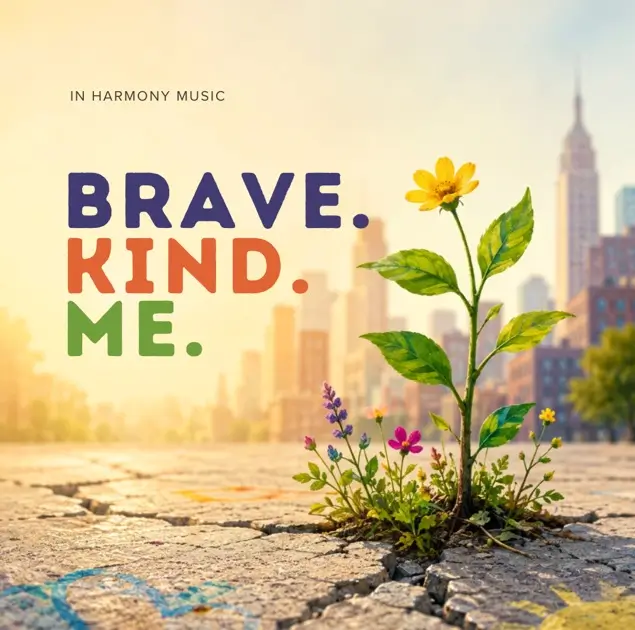
With Brave. Kind. Me., In Harmony Music creates an album that gives families more than something to listen to. It gives parents a natural way to talk with children about friendship, belonging, empathy, confidence, and becoming comfortable with who they are.
Parenting has always involved difficult conversations, but the subjects children are asked to navigate today can feel increasingly complicated. Parents want their children to be kind without becoming afraid of difference. They want them to be confident without becoming self-centered, empathetic without losing their own boundaries, and capable of forming meaningful friendships while understanding that not every relationship will be easy. They want to help their children talk about emotions, but finding the right words at the right moment can be one of the hardest parts of parenting.
Sometimes, the most effective conversations do not begin with a conversation at all. They begin with a song.
That idea is central to Brave. Kind. Me., the newest album from In Harmony Music, founded by Justine Chadly in 2003. Released August 30, 2026, the album was created from more than two decades of Chadly’s experience working with children, families, and educators. Its songs explore belonging, friendship, empathy, inclusion, confidence, and self-expression while maintaining something that is often lost when children’s music attempts to address serious subjects: the freedom to simply have fun.
For parents, that balance may be the most valuable aspect of the project. Brave. Kind. Me. does not ask families to sit down and have a formal lesson about emotional development. Instead, it gives parents something they can incorporate into the ordinary rhythms of family life. A song can play in the car on the way to school, during breakfast, while children are getting ready for bed, or in the background of an afternoon spent playing. The conversation can happen when it feels natural.
Making Difficult Conversations Feel Easier
Parents often know what they want their children to understand long before they know how to explain it. Telling a child that everyone deserves to belong is simple. Helping a child understand what belonging actually looks like when someone is different from them is more complicated. Explaining empathy is easy in theory. Helping a child recognize another person’s feelings during an argument with a sibling or friend requires experience.
Music can create a bridge between those two things.
The songs on Brave. Kind. Me. are designed around experiences children already recognize. We All Belong explores inclusion and the relationship between sameness and difference. My Friends considers the everyday challenges that come with friendship, including sharing, turn taking, and navigating relationships. A Little Bit of Love introduces empathy in a way that feels warm and accessible rather than like another instruction from an adult.
For a parent, these songs can provide an opening. A child who hears We All Belong may begin asking questions about why people are different. A child who sings My Friends may recognize something about a disagreement they had earlier that day. A parent does not necessarily need to turn those moments into a formal teaching opportunity. Sometimes asking a simple question about what the song means to the child is enough.
The music creates the invitation. The parent provides the relationship.
Children Need Joy Too
There is another reason the album works particularly well from a family perspective: it understands that children need joy as much as they need guidance.
Parents today are often surrounded by information about what they should be doing to support their children’s development. There are recommendations about routines, learning, screen time, emotional regulation, social skills, and academic preparation. All of those considerations may have their place, but childhood cannot become a continuous improvement project.
Children need to laugh.
They need to move.
They need to make up games, repeat ridiculous phrases, dance around the room, and sing the same song so many times that the adults in the house know every word.
That spirit is present in songs such as Elbow Macaroni and Baila. They bring humor, movement, and play into the album and provide an important counterbalance to its more reflective themes. The message is not that every moment of music needs to accomplish something. Sometimes music can simply make a child happy.
That is valuable in itself.
Music That Becomes Part of Family Memory
Parents often underestimate how quickly music becomes attached to memory. A song heard repeatedly during a particular stage of childhood can eventually transport a person back to a place, a family routine, or a particular feeling years later.
This is one of the reasons children’s music can have such a lasting role in family life. The songs children hear are not necessarily isolated pieces of entertainment. They can become part of the soundtrack of growing up.
A family may associate a particular song with the drive to school, a summer vacation, a sibling dancing in the living room, or a child learning to sing independently. The music becomes part of the story of the family.
Brave. Kind. Me. is particularly suited to that kind of shared listening because its themes are relevant to both children and adults. A parent can enjoy the music without feeling that it was created solely for a classroom, while a child can engage with it without feeling as though they are being taught.
That shared experience matters.
A Parent Does Not Have to Have All the Answers
One of the quieter messages within the project is that parents do not need to have a perfect response to every emotional challenge their children encounter.
Children are constantly asking questions that adults cannot always answer immediately. Why doesn’t someone want to play with me? Why does that person look different? Why did my friend say that? Why do I feel angry? Why can’t everyone be my friend?
Music can create a little breathing room around those questions.
Instead of immediately providing an explanation, a parent can listen alongside the child. A song can give the family a shared reference point and allow the child to lead the conversation. That can be especially useful for children who find it easier to communicate indirectly or through creative experiences.
The goal is not to turn parents into therapists or teachers in their own homes. It is to recognize that everyday family interactions can create meaningful opportunities for connection.
In Harmony’s approach is built around that idea. The music is not intended to replace the relationship between a parent and child. It is designed to strengthen opportunities for that relationship to develop.
Created by Someone Who Has Spent Twenty Years Listening to Children
Chadly’s experience is an important part of what distinguishes the album. Since founding In Harmony Music in 2003, she has spent more than twenty years working directly with children, educators, and families. That experience has shaped an understanding of what children respond to and what adults sometimes overlook.
Children do not always need another adult telling them what they should feel.
They need opportunities to experience connection.
They need room to experiment with their voices.
They need permission to be silly and serious in the same afternoon.
They need adults who will listen.
That philosophy is reflected throughout Brave. Kind. Me. The album does not attempt to create a perfect version of childhood. Instead, it acknowledges the complexity of growing up while giving children a musical environment in which they can explore it.
The Full Circle That Parents Will Understand
There is an especially meaningful story behind the album that may resonate with parents who spend years wondering what their children will remember from childhood.
Several of the musicians featured on Brave. Kind. Me. were once Chadly’s students. They have since grown into musicians themselves and returned to collaborate on the project.
For Chadly, that creates a remarkable full circle. The children she once taught are now adults contributing their own creativity to music intended for another generation of children.
For parents, there is something reassuring in that story. Much of parenting is invisible work. A parent reads the same book again, listens to the same story, drives to another lesson, attends another school event, answers another question, and wonders whether any of it will matter years later.
It does.
Children carry pieces of their early experiences with them. Sometimes those pieces become memories. Sometimes they become skills. Sometimes they become confidence. And sometimes they become the foundation of a creative life.
The former students returning to Chadly’s album offer a particularly tangible example of that process.
A Foundation Built Around Connection
The work behind Brave. Kind. Me. extends beyond the album through the In Harmony Foundation, which works with schools, libraries, therapists, and community partners supporting children experiencing isolation, trauma, and disconnection.
For parents, that broader mission reinforces the album’s central message. Children thrive within networks of connection. Family is one part of that network, but children also develop through relationships with teachers, friends, mentors, caregivers, and community members.
Music can travel across all of those spaces.
A song heard at home can appear again in a classroom. A melody introduced by a teacher can become something a child sings with a parent. A song about friendship can become part of a conversation between a child and caregiver. The same piece of music can mean something slightly different to everyone who hears it.
That flexibility is one of the reasons music remains such a powerful part of family culture.
Giving Families Something to Share
Ultimately, Brave. Kind. Me. is not asking parents to add another responsibility to an already demanding life. It is offering something they can simply share with their children.
Listen together. Sing together. Dance together. Laugh at the silly songs. Talk about the ones that make a child curious. Let the music become part of the ordinary moments that make up family life.
The album’s themes of courage, kindness, belonging, and self expression are important, but they do not need to be delivered as a lecture. They can emerge gradually through repetition, conversation, play, and shared experience.
That may be the most valuable thing a children’s album can offer.
Parents cannot control every experience their children will have. They cannot prevent every friendship from ending, every disappointment from happening, or every difficult emotion from arriving. What they can do is create an environment in which children know they have somewhere to return, someone willing to listen, and permission to become themselves.
Music can be part of that environment.
After more than two decades in the classroom, Justine Chadly has created Brave. Kind. Me. as a reflection of that belief. It is music for children, but it is also music for the people raising them. It gives families an opportunity to listen together, talk naturally, move freely, and create memories that may last much longer than the song itself.
In the end, perhaps the most meaningful part of the album is not what it teaches children.
It is what it gives parents an opportunity to do with them.
Learn more: https://InHarmonyMusic.com
Instagram, Facebook & YouTube: @inharmonmusicca
In Harmony Foundation Instagram & YouTube: @inharmonyfoundation

WeeklyMinds.com is proud to feature an author who brings a wealth of knowledge and experience to our blog. Weekly Minds is an accomplished freelancer writer with 12 years of experience in the field.
WeeklyMinds.com has a passion for sharing insights and perspectives on political, news, technology, home improvement, interiors and many more. Their unique perspective on current affairs has been featured in numerous publications and they have been a guest speaker at college fests.
WeeklyMinds.com is also an avid interest in writing and reading and enjoys singing, music, shopping, travelling and some more. In their free time, they can often be found of reading the novels and various current topics.
We are thrilled to have Elia Scala as a contributor to WeeklyMinds and look forward to their continued insights and contributions to our blog.