

Beginning
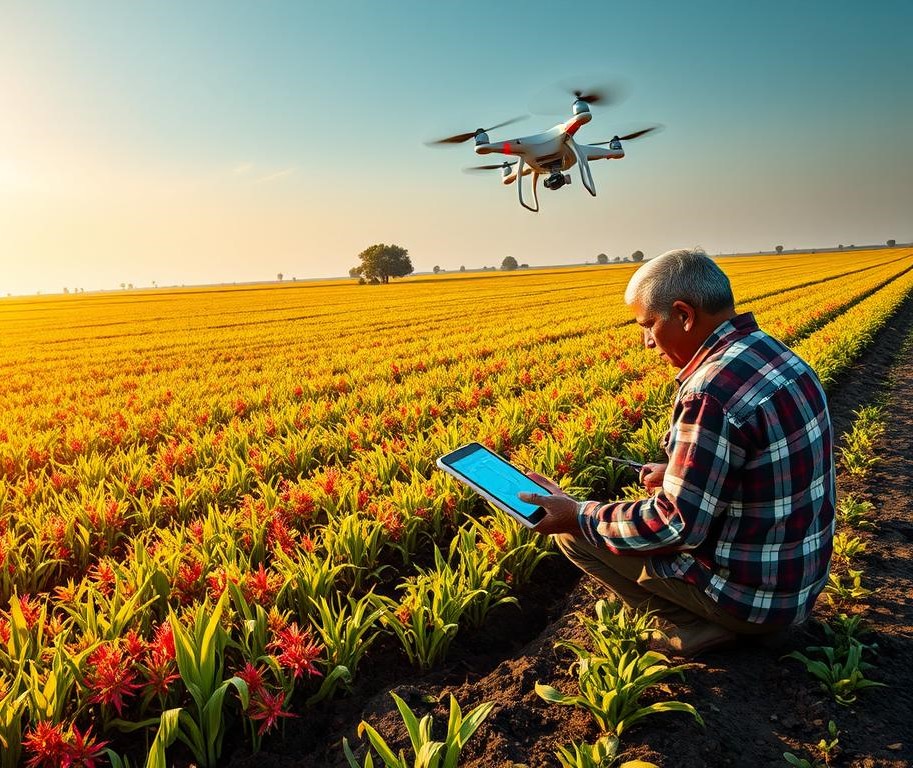
Agriculture is at a very important point in its history. The world needs to make more food with fewer resources because the population is expected to reach nearly 10 billion by 2050 and climate change is making resources scarcer. Artificial Intelligence (AI) is one of the most promising ways to solve this problem. It has the power to change things for the better and make the whole agricultural value chain more productive, sustainable, and resilient.
Adding AI to farming, which is also known as “AgTech” or “Digital Agriculture,” is changing the way farmers grow crops, take care of animals, use resources, and make important business decisions. AI is making a new era of precision agriculture possible. This is where every input is carefully calibrated for maximum efficiency and minimum environmental impact. For example, computer vision systems can find crop diseases and machine learning algorithms can predict yield outcomes.
The Current State of Agriculture Around the World
Farmers all over the world are under more and more pressure. Traditional farming methods are becoming less and less useful for meeting modern needs, even though they have been around for a long time. Some of the biggest problems are:
Lack of Resources: More than two billion people around the world don’t have enough water, and about 33% of the world’s land is losing its ability to grow crops. Farmers have to do more with less.
Climate Variability: Unpredictable weather makes it harder to plan when to plant, expect pests and diseases, and make sure the harvest goes well. More and more crops are failing, and when they do, they are worse than before.
Labor Shortages: Many farming areas are having a hard time finding workers during important harvest times because younger people are moving to cities to look for better-paying jobs.
Economic Pressure: There isn’t much room for waste or inefficiency when profits are low. A lot of small and medium-sized farms don’t have much money saved up, so they are at risk when the market changes or when things go wrong.
Food Safety and Traceability: People want to know more about where their food comes from, how it was made, and what quality standards it meets. However, the systems that are used to track food are still not very good.
These problems are all linked together, so we need new ideas to solve them. AI gives us useful tools to deal with all of these problems.
AI-Powered Farming with High Accuracy
Precision agriculture uses data and advanced analytics to make every part of farming better. AI is the technology that makes precision agriculture smart and flexible.
Checking on crops and finding diseases
Deep learning-based computer vision systems can look at pictures from drones, satellites, or ground-based cameras to find problems with crops’ health long before they are visible to the naked eye. These systems are able to:
Detect early signs of fungal infections, bacterial diseases, and viral pathogens at the plant level. This lets farmers treat only the areas that are affected with targeted interventions instead of spraying pesticides all over the field. This cuts down on chemical use by as much as 40% and makes crops more likely to survive.
Farmers can figure out which nutrients are missing by looking at the color and texture of the leaves. This lets them apply the right amount of fertilizer to the right places. This method has been shown to boost yield by 15–20% while cutting fertilizer use by up to 30%.
Keep an eye on pest populations in real time and send out alerts when infestations reach levels that are bad for business. Also, suggest the best and most environmentally friendly ways to control them.
You can predict the final yield weeks before harvest by keeping track of how fast plants grow and how buildings are built. Farmers can make better decisions about their inventory and marketing with this information.
Predicting and forecasting yield
Machine learning models that use historical data, current growing conditions, weather patterns, and soil characteristics can predict crop yields with amazing accuracy, usually within 5–10% of what actually happens. This ability to predict lets farmers:
Plan harvesting and the work that comes after it better so that there is less waste and the best time for the best quality.
Make smart marketing choices, set prices, and find buyers who are sure of how much they can make.
Change your management practices during the growing season based on predictions of low yields, and take steps to fix the problems.
Instead of relying on averages or your gut feeling, learn about the probability distribution of possible yields to better manage risk.
Improving Irrigation
In farming, water is often the most valuable resource. AI systems that use soil moisture sensors, weather forecasts, and models of how much water crops need can:
Find out how much water each growth stage needs and give it to the plant at the best time for it to use it. This method can cut water use by 20–30% while keeping or even raising yields.
Take into account how different parts of a field are different from each other. Use different irrigation methods for areas with different types of soil, terrain, and drainage.
Based on seasonal climate forecasts, guess how much water will be available and make long-term plans for irrigation.
Find system problems right away so that leaking pipes or clogged drip lines don’t waste water.
Animal welfare and livestock management
AI applications go far beyond growing crops. They also help with managing livestock by making them more productive, healthy, and happy.
Watching Your Health and Finding Diseases Early
Wearable sensors on each animal constantly gather information about its behavior, temperature, activity levels, and other physiological signs. AI algorithms look at these data streams to find early signs of illness. This lets farmers separate sick animals from the rest of the herd and treat them before the disease spreads. This method:
It lowers the use of antibiotics by treating infections earlier, when they are more likely to respond to treatment. This is an important global health issue because of antibiotic resistance.
Stops the huge losses that come with livestock disease outbreaks, especially in intensive production systems where disease can spread quickly.
Helps individual animals by letting them get help early for painful or debilitating conditions.
Managing Reproduction
AI systems can help make better breeding decisions by looking at genetic data, health records, and performance metrics to find the animals that are most likely to have healthy, productive offspring. With high accuracy, precision timing systems can predict estrus cycles. This increases fertility rates and shortens the time between reproductive events.
Improving Feeding
Different animals need different kinds of food depending on their genetics, age, health, and stage of production. When you combine computer vision systems with machine learning, you can:
Check the condition of your body in real time and change your feeding plans to keep your weight and energy levels at their best.
Improve feed conversion efficiency and lower the environmental impact of too much nutrient excretion by optimizing feed formulations to balance nutrition and cost.
Find changes in feeding behavior that could mean health problems or stress.
Supply Chain Optimization and Traceability
AI changes the way agricultural products move through supply chains after they leave the farm.
Blockchain and Following
AI systems and blockchain technology work together to make everything clear from the farm to the customer. You can keep track of every product in the supply chain, and the records are permanent.
Farming methods and input use that let people check claims about organic, fair-trade, or other quality.
Conditions for transportation and storage that make sure products have been handled properly.
Records of testing and certification that give people confidence in the safety and health claims of food.
This traceability makes food safer by allowing for quick identification and containment of contamination events. It also protects farmers’ reputations and allows them to charge more for high-quality goods, which builds consumer trust.
Forecasting Demand and Managing Inventory
Machine learning models that look at past sales data, seasonal trends, promotional calendars, and outside factors like the weather and the economy can make very accurate predictions about demand. This ability lets supply chain managers:
Cut down on food waste by making sure that your inventory levels and distribution patterns are as good as they can be.
Make sure that products move through supply chains faster to keep them fresher.
Balance supply and demand better, which will lower price swings and raise profits for both farmers and stores.
Farm Business Management and Market Insights
Farmers can use AI-powered analytics to get useful business information.
Managing Money
AI-powered specialized agricultural accounting software can:
Keep track of input costs in great detail so you can find ways to cut costs.
Look at profitability at the level of a field, crop, or animal to find out which parts of the business are really making money.
Create scenarios to see how different management choices will affect the bottom line.
Show how a farm is doing compared to similar farms, showing where it is doing better or worse than its peers.
Managing Risk
AI systems can look at a lot of different risk factors, like changes in the weather, changes in commodity prices, the risk of disease, and the availability of workers. This helps farmers come up with strong plans to protect their businesses. AI-driven analysis can help you get the most out of weather derivatives, crop insurance products, and hedging strategies.
Adopting sustainable practices
Machine learning models can suggest eco-friendly practices that are specific to each farm’s needs, showing that it makes economic sense to do so. AI can:
Help farmers figure out how long-term investments in sustainability can make them more money by calculating the return on investment for conservation measures.
Go beyond general advice on how to be more environmentally friendly and find the most useful and cost-effective ways to do things for each situation.
Check to see if claims for premium markets or subsidy programs are true by keeping track of environmental improvements that come from changes in practice.
Things to Think About and Challenges
AI has a lot of potential, but there are a lot of problems that need to be solved before it can be used in farming.
Cost and Access to Technology
Small and medium-sized farms often don’t have the money to buy new technology or the know-how to set it up and keep it running. The digital gap between big businesses and small farms could make existing problems in agriculture worse.
Solution: Open-source AI tools, cloud-based services with pay-as-you-go pricing models, and cooperative arrangements where multiple farms share technology infrastructure can make AI capabilities available to more people.
Privacy and Ownership of Data
People are worried about who owns agricultural data, who can get to it, and how it will be used as it becomes more valuable. Farmers are concerned that sharing production data with tech companies could hurt their competitiveness or reveal private information about how they run their businesses.
To build trust in AI systems, there must be clear data governance frameworks, contractual protections, and industry standards that make sure farmers own and control their data.
Working with current infrastructure
Many farms have technology systems that don’t talk to each other, which makes it hard to use AI solutions that rely on combining data from different sources.
To make integration easier, invest in standardized data formats and interoperable platforms, just like how weather data is shared across agriculture.
Uncertainty in the rules
Different places have different rules about how to use drones, apply pesticides, handle data, and other parts of AI-enabled farming. This makes things unclear and makes it harder to invest in new technologies.
Solution: Clear, consistent rules that are the same all over the world but can be changed to fit local needs can help reduce uncertainty and encourage new ideas.
Concerns about the environment and fairness
AI-driven optimization might only help big farms, and it might even make smaller farms feel more pressure to use the same technologies, which could speed up the consolidation of agriculture. Some people who care about the environment are worried that pure yield optimization doesn’t take into account important ecological factors like biodiversity and the health of ecosystems.
Solution: To make sure that technological advances support broad sustainability goals, AI systems should be designed with clear goals for environmental and social equity, not just yield and profit maximization.
Success Stories and How They Work in Real Life
Farms and agricultural groups all over the world are already seeing the benefits of AI in farming.
Precision Viticulture in Wine Regions: Wineries are using AI-powered sensors and computer vision to manage vineyard health and pick grapes at the best time with never-before-seen accuracy. This leads to better wine quality and more efficient use of resources.
Smallholder Rice Farming in Southeast Asia: Mobile AI tools are helping small-scale rice farmers figure out what diseases and pests are affecting their crops by using photos from their smartphones. The suggestions are then translated into local languages and tailored to their specific needs.
Robotic milking systems with AI can keep an eye on the health, milk composition, and productivity of each cow. This makes herd management easier and cuts down on the amount of work that needs to be done.
Controlled Environment Agriculture: AI systems improve the conditions for growing plants in greenhouses and vertical farms by controlling temperature, humidity, light, and nutrient delivery. This maximizes yield and quality while using as few resources as possible.
Companies are using AI to process satellite images and guess how much carbon is in the soil. This helps farmers keep track of carbon sequestration, get into carbon credit markets, and make the soil healthier.
What AI Will Do in the Future of Farming
Several new trends that are starting to show up will change farming even more in the future.
Networks of the Internet of Things (IoT)
As sensors get cheaper and better, dense networks of IoT devices will give AI systems real-time, hyper-local data about how plants are growing. This will let AI systems make more accurate suggestions and make automatic changes.
Systems that work on their own
AI-powered self-driving tractors, robotic weeders, and automated harvesting equipment will make it easier to do physically demanding tasks and let you do them at the best time, no matter how many workers are available.
Using generative AI to share knowledge
Farmers can get personalized advice from large language models trained on agricultural knowledge, just like having an experienced agronomist as a permanent advisor. This ability could be very useful in developing areas where there aren’t many experts to turn to for help.
Adapting to Climate
AI systems will be very important for helping farming adapt to climate change by finding and suggesting crop types, management methods, and planting patterns that will work well in the future.
Carbon Markets and the Environment
AI will be very important for measuring, verifying, and making money from environmental outcomes as carbon markets grow and consumers want proof of sustainable production.
In conclusion,
AI is not a far-off dream for farming; it is already changing how food is made. AI applications are already helping farmers, consumers, and the environment in many ways, such as by allowing for more accurate crop monitoring, better resource management, smarter livestock systems, and more open supply chains.
But to fully realize AI’s potential in farming, it needs to be put into practice in a way that takes into account real worries about access to technology, data ownership, environmental impact, and fairness. When developed and used responsibly, AI can make farming more productive, sustainable, and resilient. It can help feed a growing global population while using fewer resources and harming the environment less.
The farms and agricultural groups that are leading this change are showing that AI is not only scientifically powerful, but also economically useful. AI-powered farming will become more common as costs go down and more people start using it.
The question is no longer if AI will change farming, but how quickly we can use these technologies fairly and make sure that everyone benefits from them. Getting this right is important for a world that is dealing with food security problems and climate change.

WeeklyMinds.com is proud to feature an author who brings a wealth of knowledge and experience to our blog. Weekly Minds is an accomplished freelancer writer with 12 years of experience in the field.
WeeklyMinds.com has a passion for sharing insights and perspectives on political, news, technology, home improvement, interiors and many more. Their unique perspective on current affairs has been featured in numerous publications and they have been a guest speaker at college fests.
WeeklyMinds.com is also an avid interest in writing and reading and enjoys singing, music, shopping, travelling and some more. In their free time, they can often be found of reading the novels and various current topics.
We are thrilled to have Elia Scala as a contributor to WeeklyMinds and look forward to their continued insights and contributions to our blog.