

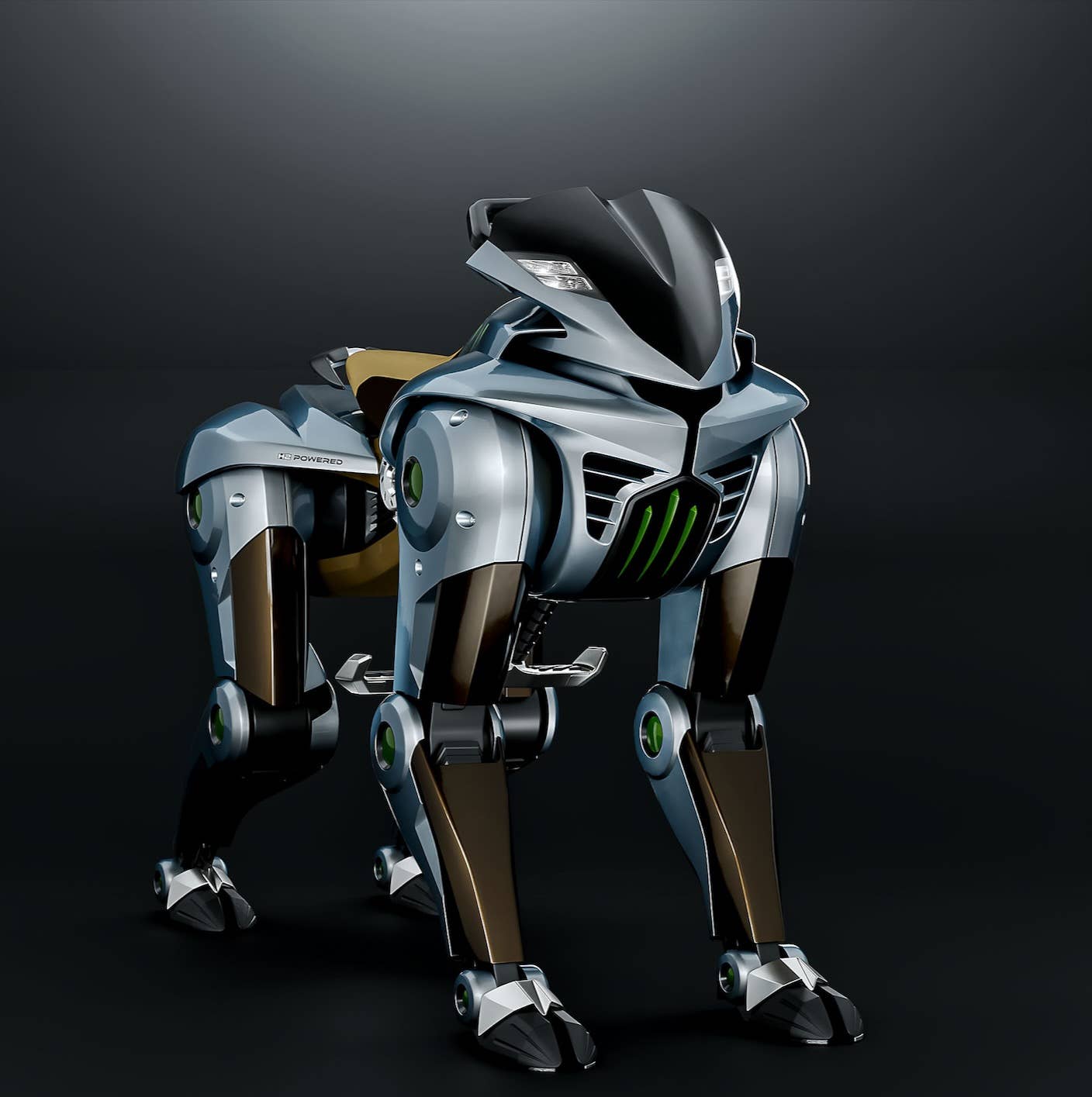
Kawasaki Heavy Industries has gotten into something really crazy in a world where electric cars are all over the news and four-legged robots are only in warehouses or research labs: Corleo is a robotic horse that runs on hydrogen and can be ridden. It is meant to be able to handle rough terrain like a cybernetic stallion from a sci-fi Western. This amazing idea was shown off at the Osaka-Kansai Expo 2025 earlier this year. It combines the company’s long history of making motorcycles with cutting-edge robotics and clean energy technology. Kawasaki’s bold vision for personal mobility in 2050 includes this gadget. In that year, horses won’t eat hay; they’ll eat hydrogen canisters.
A mechanical horse made from bikes and robots
Kawasaki, a Japanese company that has been making high-performance motorcycles like the Ninja series and industrial robots since 1989, used its two areas of expertise to make Corleo. The robot’s body is made of lightweight metal and carbon fiber, and it has a “head” fairing that makes it look like a horse. This is similar to the streamlined fairings on Kawasaki’s street bikes. But don’t be fooled by the horse-like looks; Corleo is a four-legged animal made for speed, and it can easily climb mountains, boulders, and streams by copying the way deer or panthers walk.
The engine at its heart is a 150cc hydrogen combustion engine that powers four independent actuators in its legs. This setup only lets out water vapor, which is in line with Japan’s goal of making technology that doesn’t add to carbon emissions. There is a canister slot on the side of the robot where riders can “refuel.” This means that they can quickly switch out batteries, which take hours to charge. The rubberized “hooves” split like a goat’s for better grip, and Kawasaki says they absorb shocks and don’t slip as well as regular motorcycle suspensions.
What happened? A two-seater off-roader that can trot, jump over things, climb stairs, and even crawl down steep hills—things that most ATVs can’t do.
Riding the Future: AI Smarts and Easy Control
Corleo is as easy to use as its real-life muse, so you don’t need any throttles or joysticks. Riders sit on a floating saddle that looks like a bobber motorcycle and put their feet in adjustable stirrups. You steer by moving your body: if you shift your weight to the left or right, the robot will change its stride to match. Kawasaki calls this “unity between human and machine,” which is good for beginners. It’s like riding a horse, but you won’t get thrown off.
The brains of the AI vision systems scan the terrain in real time to find paths and project holographic markers onto the ground using a heads-up display (HUD) on the “neck.” The panel shows the levels of hydrogen, route data, center-of-gravity balance, and stability metrics, making every trip feel like a video game. Kawasaki is keeping the exact specs for the 2050 rollout, so we don’t know how fast or far it can go. But early demos show that Corleo can handle everything from city parks to rough trails, and it might even be able to go longer than people can.
Kawasaki has done this before with hydrogen. They showed off the Ninja H2 HySE, a hydrogen-powered motorcycle that was tested at Suzuka Circuit last year. Corleo adds to that by including Kawasaki’s O’Cuvoid hydrogen generator for power on the go. This makes it an eco-friendly alternative to gas-guzzling dirt bikes.
Why now? A little bit of sci-fi swagger, innovation, and sustainability
Corleo comes at a key time when emissions are rising and off-road fans are looking for greener thrills. Hydrogen technology promises longer ranges and faster refueling than batteries, which is important for adventures in remote areas where charging stations are as hard to find as parking spots in Tokyo. Kawasaki’s bet is that legged robots like this one could be more useful than wheeled vehicles, especially for responding to disasters, exploring, or just having fun driving through Japan’s mountainous backcountry.
What did the public think? Powered by electricity. People on social media called it the “Cybertruck on legs” or a “Power Rangers mount.” People on forums are arguing about how useful it is—those complicated legs scream high maintenance costs. Competitors like China’s XPeng are making rideable robo-ponies, but they’re only kid-sized and run on batteries. Corleo’s adult size and hydrogen torque make it different. Critics say that hydrogen’s infrastructure problems (like not having enough refueling stations) are a problem, but supporters say that these problems are a way to get more people to use it.
Corleo stole the show at the Expo, where the main theme was “future societies.” He embodied Kawasaki’s motto: “Preserve the thrill of riding while harmonizing with nature.” It reminds us that new ideas often come in unexpected ways.
The Long Trail Ahead: From Idea to Corral
Corleo is still a prototype for now, and there is no set date for when it will go on sale, other than the vague 2050 date. Kawasaki hasn’t said anything about prices or problems with making the prototypes, but since the Expo is over and the buzz is still going strong, expect to see more prototypes at other events soon. Will it take the place of your dirt bike? Or turn into a luxury toy for eco-adventurers? Only time—and a few refills of hydrogen—will tell.
One thing is for sure: the horse has changed in Kawasaki’s world. And it’s ready to ride into the future, one clean-powered gallop at a time.

WeeklyMinds.com is proud to feature an author who brings a wealth of knowledge and experience to our blog. Weekly Minds is an accomplished freelancer writer with 12 years of experience in the field.
WeeklyMinds.com has a passion for sharing insights and perspectives on political, news, technology, home improvement, interiors and many more. Their unique perspective on current affairs has been featured in numerous publications and they have been a guest speaker at college fests.
WeeklyMinds.com is also an avid interest in writing and reading and enjoys singing, music, shopping, travelling and some more. In their free time, they can often be found of reading the novels and various current topics.
We are thrilled to have Elia Scala as a contributor to WeeklyMinds and look forward to their continued insights and contributions to our blog.