

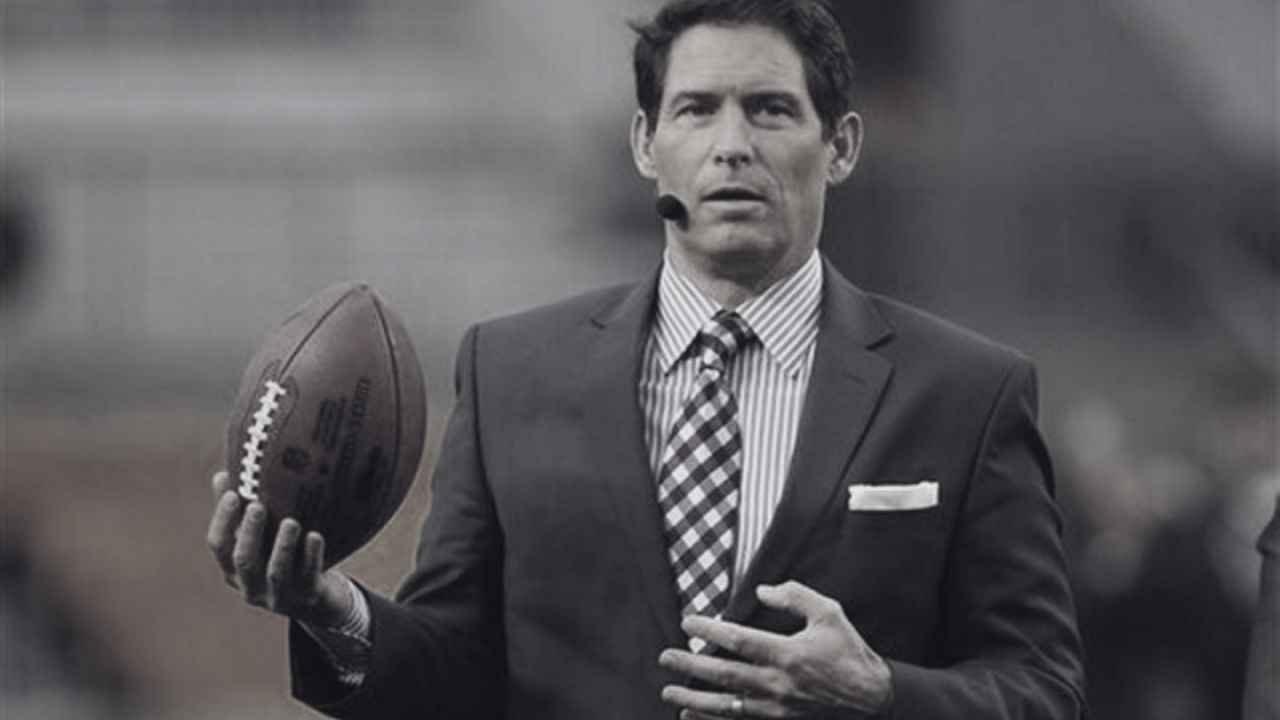

Steve Young: Hall of Fame Quarterback and Dual-Threat Pioneer
Jon Steven Young (born October 11, 1961) is a former American football quarterback widely regarded as one of the most excellent and most efficient passers in NFL history. A left-handed signal-caller, Young played 15 seasons in the National Football League (NFL), primarily with the San Francisco 49ers, where he succeeded legend Joe Montana and carved out his own legendary career. Known for his pinpoint accuracy, mobility, and leadership, Young retired as the NFL’s all-time leader in career passer rating (96.8) and remains one of the top dual-threat quarterbacks ever.
Early Life and College Career
Born in Salt Lake City, Utah, Young grew up in Greenwich, Connecticut, where he excelled in multiple sports at Greenwich High School. A descendant of Brigham Young, he attended Brigham Young University (BYU), initially starting as the eighth-string quarterback.
By his senior year in 1983, Young had transformed into a star. He led the nation in passing yards (3,902), touchdown passes (33), and completion percentage (71.3%), earning unanimous All-American honors, the Davey O’Brien Award, and finishing second in Heisman Trophy voting. His college totals included 7,733 passing yards, 56 touchdowns, and 1,048 rushing yards with 18 scores. Young was inducted into the College Football Hall of Fame in 2001.
Professional Career
Young’s pro journey began in the ill-fated United States Football League (USFL) with the Los Angeles Express (1984–1985), where he signed a massive contract but faced financial instability as the league folded.
Selected No. 1 overall in the 1984 NFL Supplemental Draft by the Tampa Bay Buccaneers, Young struggled in two seasons (1985–1986), posting a 3–16 record amid a struggling team.
In 1987, he was traded to the San Francisco 49ers for draft picks, initially serving as Joe Montana’s backup. Young saw limited action but contributed to Super Bowl victories in XXIII (1988) and XXIV (1989) as a reserve.
When Montana was injured in 1991, Young seized the starting role. From 1991 to 1998, he dominated, leading the NFL in passer rating six times (a record), touchdown passes four times, and earning two NFL MVP awards (1992, 1994). His 1994 season featured a then-record passer rating of 112.8.
The pinnacle came in Super Bowl XXIX (January 1995), where Young threw a record six touchdown passes in a 49–26 rout of the San Diego Chargers, earning MVP honors and the 49ers’ fifth championship.
Young’s mobility set him apart: He rushed for 4,239 yards and 43 touchdowns (both top marks for quarterbacks at retirement)—career stats: 33,124 passing yards, 232 touchdowns, 107 interceptions, and a 96.8 rating.
Retirement and Legacy
Plagued by concussions—suffering at least seven—Young retired in June 2000 at age 38 after a hit in 1999 sidelined him permanently. He finished with seven Pro Bowl selections and three first-team All-Pro honors.
Inducted into the Pro Football Hall of Fame in 2005 as the first left-handed quarterback enshrined, Young’s No. 8 jersey was retired by the 49ers in 2008. His efficiency records influenced modern dual-threat QBs, and he ranks among the NFL’s all-time greats.
Post-Retirement
After football, Young earned a law degree, worked as an ESPN analyst, co-founded a private equity firm, and established the Forever Young Foundation to support children facing challenges. He has advocated for concussion awareness and player safety, drawing from his experiences.

WeeklyMinds.com is proud to feature an author who brings a wealth of knowledge and experience to our blog. Weekly Minds is an accomplished freelancer writer with 12 years of experience in the field.
WeeklyMinds.com has a passion for sharing insights and perspectives on political, news, technology, home improvement, interiors and many more. Their unique perspective on current affairs has been featured in numerous publications and they have been a guest speaker at college fests.
WeeklyMinds.com is also an avid interest in writing and reading and enjoys singing, music, shopping, travelling and some more. In their free time, they can often be found of reading the novels and various current topics.
We are thrilled to have Elia Scala as a contributor to WeeklyMinds and look forward to their continued insights and contributions to our blog.