

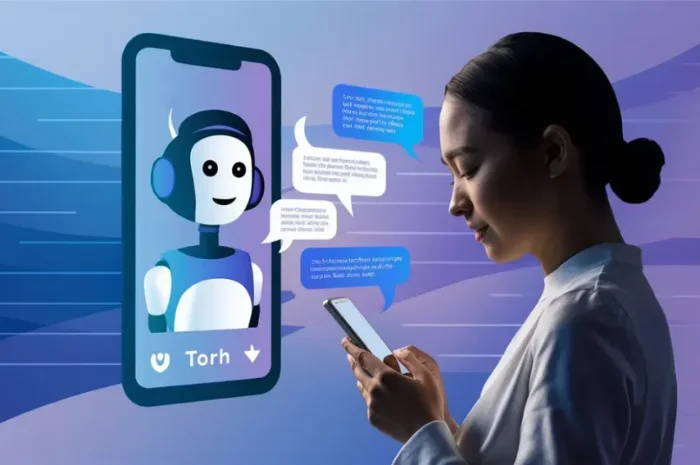
Customer expectations are higher than ever in today’s fast-paced digital world. They want quick answers, help 24/7, and help that is tailored to their needs—all without having to wait on hold or figure out complicated phone menus. Businesses in all fields are using AI-powered chatbots to meet these needs. These chatbots are changing the way customer service works. These smart virtual assistants have come a long way from being simple automated responders. Now they can understand, learn, and give customers great experiences.
AI is becoming more and more common in customer service.
Over the past ten years, the customer service industry has changed a lot. Old-fashioned call centers and email-based support systems used to be the main ways for customers to get in touch, but they often had problems with delays and inefficiencies. Companies needed a faster and more scalable way to handle questions as people became more connected online.
AI chatbots are computer programs that use natural language processing (NLP) and machine learning to act like people talking to each other. At first, chatbots were only able to do simple things like answer frequently asked questions. Now, they can handle more complicated conversations, help customers troubleshoot problems, process payments, and even suggest products. Recent reports say that more than 80% of businesses have added chatbots to their customer service plans. This shows how important they are becoming for interacting with customers in today’s world.
Available 24/7: Always Ready to Help
AI chatbots can help customers 24 hours a day, seven days a week, which is one of their best features. Chatbots are available 24/7, so every customer question gets answered. This is different from human agents, who need breaks and work in shifts.
Chatbots make sure that businesses are always available, whether it’s helping a customer late at night, answering questions during holidays, or handling support requests from people in different time zones. Being available all the time not only makes customers happier, but it also boosts the brand’s reputation by showing that it is reliable and responsive.
Quick answers and shorter wait times
In traditional customer service, long wait times and slow responses can make people angry and cause them to leave bad reviews. AI chatbots get rid of this problem by giving quick answers to common questions.
Chatbots can give you accurate answers in seconds for things like checking the status of an order, resetting a password, or finding out more about a product. Companies can cut down on customer wait times by a lot by automating routine questions. This lets human agents focus on more complicated or important interactions. The end result is a better, faster, and more enjoyable experience for customers.
Data and AI for Personalization
AI chatbots today aren’t just reactive; they’re also proactive and tailored to each user. Chatbots can give customers personalized interactions that make them feel understood and valued by looking at their data, chat history, and behavior patterns.
For instance, a retail chatbot might greet a customer who is coming back by name, suggest products based on what they have bought before, or give them special discounts for being a loyal customer. A banking chatbot can also give you personalized financial advice or remind you to pay your bills.
This level of personalization not only makes the customer experience better, but it also builds brand loyalty and raises conversion rates. Customers are more likely to have a good experience with a brand when they feel recognized and supported.
Integration without any problems across channels
Customers today talk to businesses through a lot of different channels, such as websites, mobile apps, social media sites, and messaging services like Facebook Messenger or WhatsApp. You can easily add AI chatbots to all of these platforms, which will give you a consistent and unified support experience.
For example, a customer who starts a conversation on a company’s website can pick it up later on a mobile app without losing track of what they were talking about. Chatbots keep conversations going so that users don’t have to repeat what they said. This ability to connect with customers through many channels helps businesses build stronger relationships with them.
Not replacing human agents, but making them better
Many people think that AI chatbots are meant to take the place of human agents. In reality, they are made to help people do their jobs better by automating boring tasks and giving agents quick access to the information they need.
When a chatbot gets a question it can’t answer, it can easily hand the conversation over to a live agent. The bot will often give the agent background information to help them pick up where the bot left off. This mixed support model makes sure that customers get the best of both worlds: the speed and efficiency of AI and the empathy and understanding of talking to a person.
Chatbots also help human agents behind the scenes by getting information, suggesting responses, and analyzing sentiment in real time. This cuts down on the time it takes to handle things and lets agents focus on tough problems that need human judgment.
Cost-effectiveness and the ability to grow
Running a business can be very expensive, especially when you have to hire more people to handle more customers. Hiring, training, and managing big support teams can quickly raise the cost of doing business.
AI chatbots are a cheap and easy-to-scale solution. They can handle thousands of conversations at once without needing to hire more people. This feature is especially helpful for small and medium-sized businesses because it lets them offer enterprise-level support on a tight budget.
Chatbots make call centers a lot less busy for big companies, which cuts down on overtime costs and makes everything run more smoothly. The outcome is a customer support model that is better for the environment and costs less.
Insights from data for ongoing improvement
Every time a customer talks to a chatbot, it collects useful information about how they act, what they like, and what problems they have. Companies can use these insights to find common problems, make their products better, and improve their customer service plans.
For instance, if a chatbot sees that a lot of people are complaining about shipping delays, the company can look into the problem and fix it. AI-powered sentiment analysis tools can also measure how happy customers are in real time. This helps businesses deal with problems before they get worse.
Chatbots learn and get better over time through machine learning, which makes them more accurate, intuitive, and useful with each conversation.
Support for many languages and a global reach
In a global market, businesses often have to deal with customers who speak different languages. It can be hard and expensive to hire support agents who speak more than one language. AI chatbots, on the other hand, can talk to people in many languages, which makes it easier for them to talk to each other and reach more customers.
This feature makes sure that everyone can use it, which makes customers around the world happier. A single chatbot can help people in many different markets, whether they speak English, Hindi, Spanish, or French. There is no need for separate support teams in each region.
Using empathy and emotion recognition to make the customer experience better
Chatbots are better at picking up on tone, sentiment, and emotion in text thanks to improvements in emotional AI and natural language understanding (NLU). This lets them change how they respond based on how the customer is feeling.
For example, if a chatbot sees that someone is upset, it can show that it understands their feelings, admit that there is a problem, and send the question to a human agent. Interactions that are emotionally smart like this make for a more human and caring customer service experience, which builds trust and lowers conflict.
What AI chatbots will do in the future for customer service
The role of chatbots in customer service will only get stronger as AI technology gets better. Future chatbots will have better voice recognition, predictive analytics, and more connections to CRM systems. Not only will they answer questions, but they will also be able to predict what customers will need and offer solutions before problems even come up.
Also, using Generative AI will let chatbots have conversations that are more natural, dynamic, and full of context, making them almost impossible to tell apart from real people. Companies that start using these advanced tools early will have a big edge over their competitors when it comes to keeping customers happy and engaged.
In conclusion
AI chatbots are changing customer service from something that happens after the fact to something that is proactive, smart, and focused on the customer. They put speed, reliability, customization, and cost-effectiveness front and center—things that today’s customers want.
Businesses can make a customer service system that works well, is easy to grow, and is satisfying by combining the analytical power of AI with the empathy of human agents. The future of customer service will be shaped by the relationship between people and AI chatbots, one conversation at a time.

WeeklyMinds.com is proud to feature an author who brings a wealth of knowledge and experience to our blog. Weekly Minds is an accomplished freelancer writer with 12 years of experience in the field.
WeeklyMinds.com has a passion for sharing insights and perspectives on political, news, technology, home improvement, interiors and many more. Their unique perspective on current affairs has been featured in numerous publications and they have been a guest speaker at college fests.
WeeklyMinds.com is also an avid interest in writing and reading and enjoys singing, music, shopping, travelling and some more. In their free time, they can often be found of reading the novels and various current topics.
We are thrilled to have Elia Scala as a contributor to WeeklyMinds and look forward to their continued insights and contributions to our blog.