

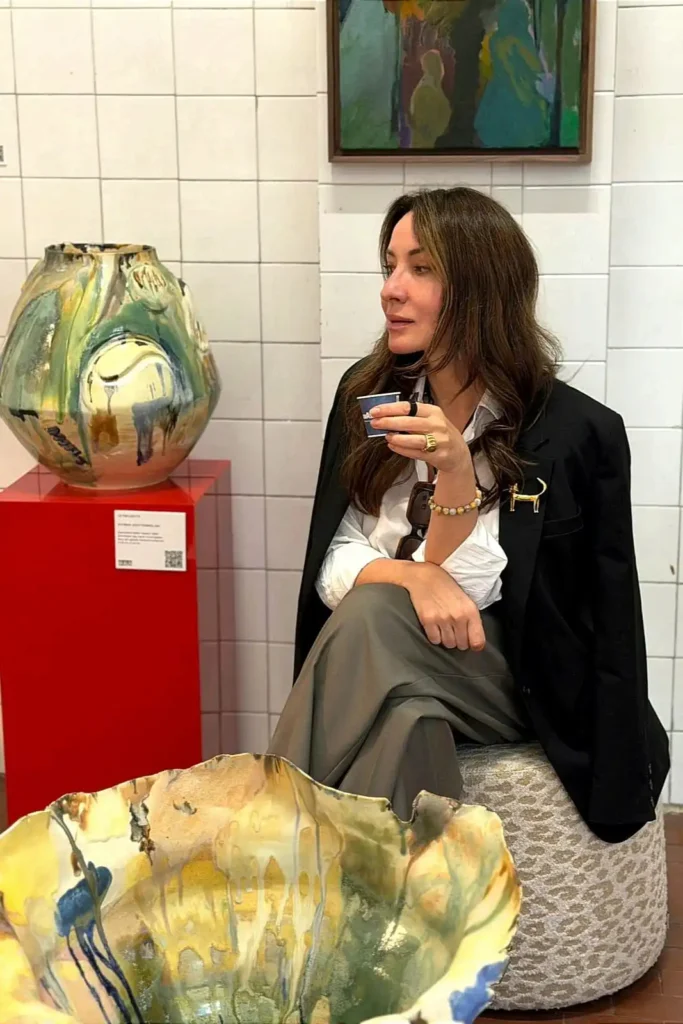
Ekaterina Luki is the founder of LÉ Projects – an art consultancy operating across London, New York, Milan and Odessa. Founded in 2015, LÉ Projects is working at the intersection of art collecting, curation, and immersive travel experiences, connecting collectors directly with artists, galleries, and design studios worldwide.
Ekaterina studied Modern and Contemporary Art at Christie’s in London and has curated exhibitions across Europe and the US. This April, LÉ Projects returned to MEGA Art Fair in Milan for its third consecutive edition, focusing on three women artists alongside a rare selection of limited edition jewellery by 20th Century Masters.
Why contemporary collecting is becoming more and more experience-driven, how art is moving beyond the traditional gallery booth exhibition, and why contemporary artists are being shown alongside surrealist jewellery pieces from the 20th century — read the interview with Ekaterina Luki, founder of LÉ Projects.
LÉ Projects describes itself as an art consultancy, but it operates across exhibitions, fairs, curated travel, and collecting. How do you define what you do, and why stay outside the traditional gallery format?
I’ve never really seen LÉ Projects as fitting into one category. “Art consultancy” is simply the closest shorthand, but in reality, it’s a platform for access: to artists, to places, to ways of seeing.
The traditional gallery model is built on representation and control. What I was more interested in was connection and context. I didn’t want to mediate art within a fixed space, I wanted to move it across cities, disciplines, and experiences. That’s why travel became part of the model, and why exhibitions, fairs, and collecting all sit naturally together.
You founded LÉ Projects in 2015 after years of traveling and building connections in the art world. What was the gap you saw?
At the time, everything felt very segmented. Galleries sold, advisors advised, institutions educated, but there wasn’t much that brought those worlds together in a fluid, human way.
I was visiting studios, meeting artists, and seeing processes that most collectors never have access to. I realised that the value goes beyond the artworks and very much includes the encounter. There was a lack of intimacy in how people were introduced to art. LÉ Projects came from the idea that collecting could begin with experience, not transaction.
This year you participated for the third time at MEGA Art Fair in Milan. Why did you combine contemporary women artists with 20th-century jewellery artists?
What we set out to showcase is a narrative that speaks of continuity. Artists like Salvador Dalí or René Magritte didn’t necessarily approach jewellery as something secondary. It was an extension of their visual language and a way of bringing art into life, into the body.
Placing a tight jewellery selection alongside three contemporary women artists created a dialogue across time. Historically, women artists have had to fight for recognition. Bringing these works together wasn’t about contrast; it was about recalibration.
The venue this year was PROFUMO, an ex-perfume factory. What does location mean to you?
Location is never neutral as it shapes perception before the work is even seen. PROFUMO carries associations of scent, intimacy, craftsmanship, and luxury, and these ideas resonate strongly with both jewellery and the works we presented. I am always drawn to spaces that already hold a certain emotional or sensory identity, because they allow the exhibition to exist on multiple levels. They slow the viewer down, and that’s important. Also, I am a big supporter of this fresh initiative, running side by side with the established and typical art fair that Miart is.
How do collectors approach jewellery artists?
It exists in a very interesting psychological space. People often come to it thinking it’s more accessible than fine art, but quickly realise it carries just as much conceptual depth.
When you wear a piece by someone like Amedeo Modigliani or Magritte, you’re not simply wearing something decorative – you are carrying a fragment of an artist’s vision into your everyday life. For some collectors, that intimacy is incredibly powerful. Others still separate it from “serious” collecting, but that distinction is gradually disappearing.
What makes you decide to represent an artist today?
At the beginning, it was very instinctive, almost emotional. I responded to work I felt strongly about, and to people I connected with.
Now, instinct remains essential, but I also think more long-term. I consider how an artist might evolve, how their work sits within a broader context, and whether I can genuinely support them in a meaningful way.
I am less interested in immediate impact and more in depth via work that continues to unfold over time.
Art fairs are often criticised for being too commercial. How do you approach them differently?
You can’t completely change the nature of a fair. It is fast, and it is commercial. But you can shift how people experience your space within it. What I find particularly exciting are formats that expand beyond that. My last participation in the Mega Art Fair stayed with me for that reason.
There is something incredibly fresh about what Mattia Pozzoni and Marta Orsola Sironi have created. It feels like a reimagined art fair, almost like an open, rose garden atmosphere in the middle of the city. There is air, there is time, there is space to move. The fair continues into the evening, with musicians, DJs, and conversations. It’s not just a fair, it’s an experience and a joyful celebration of art, design and people.
How does geography shape taste?
More than people realise, but for me, it’s not only about geography, it’s also about time.
Collectors in London, Milan, or New York City each have distinct sensibilities. Yet, I am equally interested in how different historical moments continue to shape what we respond to today.
I’ve always been drawn to artists like René Magritte, Leonora Carrington, Jean Cocteau, and Leonor Fini, and also contemporary voices such as Cecily Brown, Lisa Yuskavage, and Konstantina Krikzoni. What fascinates me is not only their work, but the worlds they inhabit.
If you look just one hundred years back, around the time of Surrealism, the shift in thinking was extraordinary. And yet, in the scale of human history, a century is not such a long time. Within that period, we’ve seen wars, revolutions, and profound cultural transformations and all of this shaped artistic expression in ways we are still responding to today.
I often try to connect these layers, not just place, but time. To understand how what we are seeing now relates to what was imagined, disrupted, or invented before. That dialogue across time, as much as geography, is something I find endlessly compelling, and it continues to shape how I think about artists, collectors, and the role of art itself.

WeeklyMinds.com is proud to feature an author who brings a wealth of knowledge and experience to our blog. Weekly Minds is an accomplished freelancer writer with 12 years of experience in the field.
WeeklyMinds.com has a passion for sharing insights and perspectives on political, news, technology, home improvement, interiors and many more. Their unique perspective on current affairs has been featured in numerous publications and they have been a guest speaker at college fests.
WeeklyMinds.com is also an avid interest in writing and reading and enjoys singing, music, shopping, travelling and some more. In their free time, they can often be found of reading the novels and various current topics.
We are thrilled to have Elia Scala as a contributor to WeeklyMinds and look forward to their continued insights and contributions to our blog.